China’s aluminum lift and slide doors market is expanding with premium housing, renovation, and energy-efficiency requirements. However, appearance alone cannot identify a reliable manufacturer. Thermal insulation, air tightness, drainage, hardware durability, and production consistency matter more.
The International Energy Agency reports that buildings consume approximately 30% of global final energy. This places greater attention on high-performance envelopes, including advanced door systems. Grand View Research also identifies energy efficiency and large glazed openings as important growth factors in the global windows and doors market. These findings explain why Chinese manufacturers increasingly promote thermally broken aluminum profiles, multi-point locks, insulated glass, and tested weather resistance.
Dr. Helen Sanders, a recognized building-science and fenestration specialist, offers a useful principle: “A large glass opening must perform as part of the wall, not as an afterthought.” That standard guides this China Top 10 selection. We examine factory experience, product testing, system design, hardware options, customization, certifications, and export capability. Some published performance figures are difficult to compare because laboratories and testing conditions differ. That limitation deserves attention.
The strongest suppliers should demonstrate more than attractive catalogs. They should provide section drawings, air-permeability results, water-tightness data, thermal values, installation guidance, and traceable project references. This article therefore focuses on manufacturers capable of delivering Aluminum lift and slide doors for demanding residential and commercial applications. Not every company will fit every project. That is the practical reality.
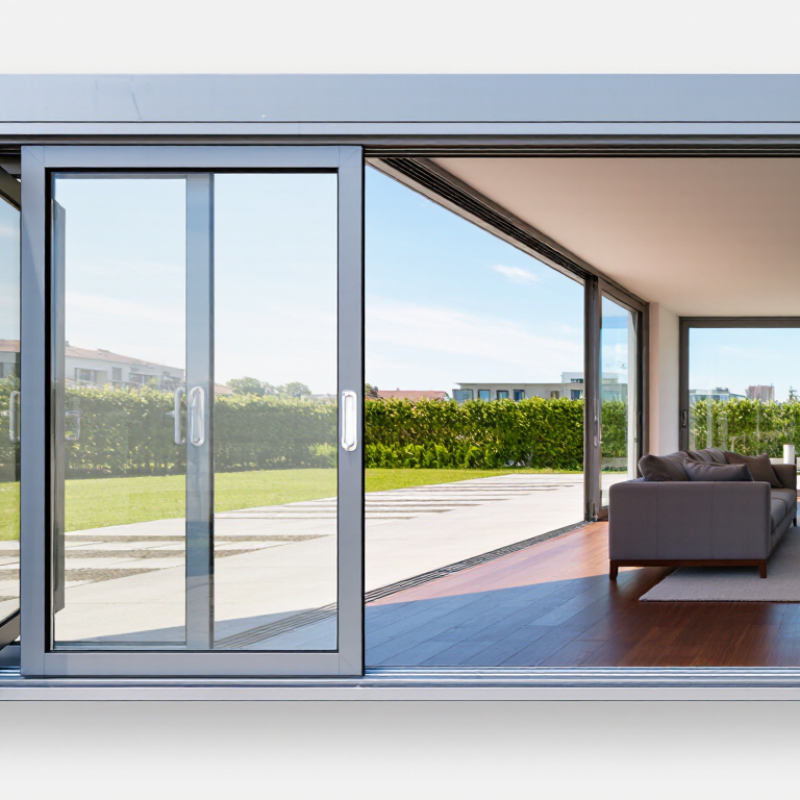
An aluminum lift-and-slide door uses a movable glass panel that lifts slightly when its handle turns. Rollers then carry it along a floor track, allowing a wide opening with less pushing force. Turning the handle back lowers the panel onto its seals. The aluminum frame provides structural support, while a thermal break can reduce heat transfer between its exterior and interior surfaces. Smooth operation depends on careful installation and a clean, level track. Dust collects quickly.
The U.S. Department of Energy estimates that heat gain and loss through windows account for about 25–30% of residential heating and cooling energy use. Large glazed doors can therefore affect comfort and energy demand, although results depend on climate, glass, orientation, and installation.
The National Fenestration Rating Council’s product ratings report measures such as U-factor and solar heat gain coefficient, helping buyers compare tested performance rather than relying on frame material alone. Check ratings for the complete door assembly. One caveat: a low U-factor does not guarantee a draft-free installation; perimeter sealing and drainage details still matter.
China’s aluminum door sector is a layered manufacturing network, not a single group of identical factories. It includes aluminum profile producers, hardware suppliers, glass processors, system designers, and door assemblers. Some companies manage several stages in-house; others buy finished profiles and focus on cutting, machining, and assembly. That distinction matters.
Production is often organized around regional supply chains. An assembler may source profiles from one province, rollers and locks from another supplier, then arrange glazing and packaging nearby. Larger operations can support project orders and custom dimensions, while smaller workshops may handle short runs or local installations. The boundaries are not always neat. A supplier described as a manufacturer may outsource key components, so buyers should ask who makes the profiles, hardware, and finished doors.
For lift-and-slide doors, the visible frame is only part of the product. Track geometry, drainage openings, glass thickness, and roller capacity affect how a heavy panel moves after installation. Ask for section drawings, hardware specifications, and a sample operating test—not just a polished catalog. A smooth showroom door can hide weak details. Even careful checks cannot remove every uncertainty; site measurements and installation quality still matter.
China’s leading aluminum lift-and-slide door manufacturers are identified by more than attractive catalogs. A serious evaluation begins with thermal performance, profile strength, drainage design, and hardware durability. Look for tested air tightness, water resistance, wind-load results, and published production tolerances. These details reveal whether a door can handle humid summers, cold winters, and repeated daily movement. Certification matters.
Experienced manufacturers explain glass options, thermal breaks, surface treatments, and installation limits in clear language. They should provide traceable material records, sample corners, inspection reports, and practical warranty terms. Factory experience also appears in small details: smooth rollers, aligned locks, clean welds, and stable color across large frames. Ask how defects are recorded and corrected, not only how products are advertised. A confident supplier welcomes difficult questions.
Still, no factory is perfect. Test results may not reflect every building site, and installation quality can change performance dramatically. That uncertainty deserves honest discussion, not polished promises.
Tips: Request a full-size operating sample whenever possible. Slide it repeatedly and listen for grinding, vibration, or uneven resistance. Compare stated values with independent test evidence. Check replacement-part availability and response times before signing. A useful review includes drawings, project references, and after-sales contacts. Choose evidence over impressive language.
Use these criteria to compare manufacturers. The table ranks evaluation factors, not individual companies; performance requirements should be matched to the project, climate, and applicable local codes.
| No. | Evaluation criterion | Evidence to request | What strong performance looks like |
|---|---|---|---|
| 1 | Verified air, water, and wind performance | Recent test reports for the relevant door configuration, dimensions, and installation details. In China, ask whether testing references GB/T 7106-2019. | Results meet the project specification and local exposure requirements; reports identify the tested specimen and test method. |
| 2 | Thermal and glazing performance | Declared whole-door thermal transmittance (U-value), glass make-up, spacer details, and calculation or test basis. | Values are stated for the complete door assembly, not only the glass or frame, and are suitable for the target climate and energy code. |
| 3 | Structural design and large-panel capability | Engineering calculations, allowable panel sizes and weights, profile sections, and project-relevant structural test reports. | The manufacturer checks the actual opening, glass weight, wind load, and support conditions rather than relying on a generic maximum-size claim. |
| 4 | Frame, finish, and corrosion protection | Alloy and temper specifications, coating process and thickness records, finish samples, and any applicable corrosion-test reports. | Specifications are documented and suited to the installation environment, including coastal or high-humidity locations where relevant. |
| 5 | Hardware, rollers, and operating effort | Hardware load ratings, roller and track details, cycle-test evidence where available, and replacement-part availability. | Hardware is rated for the specified sash weight and expected use, with smooth operation and clear maintenance instructions. |
| 6 | Drainage, sealing, and threshold design | Section drawings showing gaskets, drainage paths, weep outlets, interlocks, and threshold options. | The design explains how water is managed and how seals meet at corners, meeting rails, and the sill. |
| 7 | Quality management and production control | Current quality-management certificates, inspection plans, material traceability, and sample production or final-inspection records. | Quality procedures cover incoming materials, fabrication, assembly, inspection, and corrective actions. Verify certificate scope and validity. |
| 8 | Standards and independent testing | Test reports identifying the standard, laboratory, date, specimen, and measured results. Depending on the market, relevant references may include EN 14351-1 or applicable ASTM test methods. | Evidence is relevant to the destination market and specific product; test methods are not presented as product certifications. |
| 9 | Customization and engineering support | Shop drawings, finish and glazing options, interface details, stated tolerances, and documented design-review process. | The supplier can coordinate dimensions, installation interfaces, hardware, and local code needs before production. |
| 10 | Installation guidance, warranty, and after-sales support | Installation manuals, warranty terms, claims process, spare-parts policy, and technical-support response arrangements. | Responsibilities and exclusions are clear, and support is available for installation, adjustment, maintenance, and replacement parts. |
Profiles of 10 Chinese Aluminum Lift-and-Slide Door Manufacturers
China’s aluminum lift-and-slide door sector serves residential, hospitality, and export projects. Grand View Research’s Windows and Doors Market Report 2024–2030 projects global growth at about 6.9% annually, supported by renovation and energy-efficiency demand. The following ten profiles focus on manufacturer capabilities, not advertising claims. Several operate integrated extrusion, powder-coating, thermal-break, and assembly lines. Others concentrate on custom fabrication for villas and high-rise interiors.
The strongest candidates usually provide tested air, water, wind, and thermal data. Look for reports referencing EN 12207, EN 12208, EN 12210, or equivalent local standards. A 2023 International Energy Agency buildings report also keeps envelope efficiency central to cooling-demand reduction. That matters in southern China, where a 4.5-meter opening can face heavy rain and strong seasonal winds. Some factories offer narrow interlocks, stainless-steel rollers, laminated glazing, and low-E glass. Roller performance needs attention. Door weight changes everything.
The ten profiles should distinguish export experience, engineering depth, and production consistency. Ask for batch inspection records, corner-joint samples, coating certificates, and installation drawings. ISO 9001 certification helps, but it does not guarantee careful assembly. This is an uncomfortable point. A polished showroom may hide weak drainage design or poor site measurement. Request a full-size sample, then test the lock, handle, rollers, seals, and drainage path repeatedly. Data is useful. Hands-on checking remains necessary.
China Top 10 Aluminum Lift and Slide Door Manufacturers: How to Compare Manufacturers and Verify Their Credentials
A manufacturer should be judged by evidence, not polished showroom photos. The International Aluminium Institute reported about 70 million tonnes of primary aluminium production worldwide in 2023. That scale makes material traceability important. Ask for alloy certificates, billet origin, temper records, and batch numbers. A serious factory should connect each profile to a production date. Missing records are a warning sign.
Compare suppliers through measurable performance. Request independent test reports for air permeability, water tightness, wind resistance, thermal transmittance, and repeated opening cycles. Check the test standard, laboratory identity, sample size, and report date. ISO 9001 certification can support process control, but it does not prove door performance. The same applies to environmental certificates. They help, but they are not magic.
Visit the production line if possible. Look at corner joints, drainage paths, rollers, gaskets, and glass installation. Ask how defective units are isolated. Request two recent customer references and verify whether the delivered dimensions matched the approved drawings. The International Energy Agency identifies aluminium as a significant industrial emissions source, so ask for recycled-content data and energy reporting. Be careful here: a supplier may quote recycled aluminium without showing the calculation method. I would also compare warranty exclusions, spare-part availability, installation guidance, and response times. A low price can hide weak hardware or costly site adjustments.
Turning the handle lifts the glass panel slightly. Rollers then carry it along a floor track with less pushing force. Turn the handle back, and the panel lowers onto its seals. Dust gathers fast.
They can, but results depend on climate, glass, door orientation, and installation. Check ratings for the complete assembly, including its U-factor and solar heat gain coefficient. A low U-factor alone cannot prevent drafts around a poorly sealed frame.
Ask for tested air tightness, water resistance, wind-load, and thermal data. Reports may reference recognized standards such as EN 12207, EN 12208, or EN 12210. Compare documents with the actual door configuration.
Try a full-size operating sample if available. Slide it repeatedly and listen for grinding or vibration. Notice uneven resistance. A heavier glass panel can change roller performance considerably.
Inspect aligned locks, clean welds, stable coating color, and sample corner joints. Ask to see the drainage path and installation drawings. Attractive showroom lighting proves very little.
No. Quality-management certification can be useful, but it does not guarantee careful assembly or accurate site measurements. Request batch inspection records and traceable material information. Some uncertainty remains.
Check replacement-part availability, response times, and written warranty terms. Ask how defects are recorded and corrected. A polished promise is not a repair plan.
Not completely. Site conditions and installation quality can change the result. A test report is useful, but it cannot inspect your opening, seals, or drainage after installation. That is easy to overlook.
This guide explains what Aluminum lift and slide doors are and why they are increasingly used in modern residential and commercial buildings. It outlines how these systems combine large glass panels, durable aluminum frames, precision rollers, and advanced locking solutions to provide smooth operation, strong thermal performance, natural light, and flexible indoor-outdoor access. The article also describes the structure of China’s aluminum door manufacturing sector, including factory-based producers, engineering suppliers, customization teams, and export-oriented manufacturers.
It then presents ten representative Chinese manufacturer profiles without focusing on brand promotion, highlighting their product capabilities, production scale, customization services, quality management, certifications, and project experience. Finally, the guide offers practical criteria for comparing suppliers, such as material specifications, hardware quality, weather resistance, testing procedures, delivery capacity, after-sales support, and communication efficiency. Buyers are encouraged to verify company credentials, inspect technical documentation, request samples, and evaluate contract terms before making a purchasing decision.