Choosing Vinyl tilt and turn windows in 2026 requires more than comparing frame colors or online prices. A credible decision begins with verified performance data, installation conditions, and daily usability. The U.S. Department of Energy reports that windows can influence roughly 25%–30% of household heating and cooling energy use. That figure makes glass selection, frame insulation, and air leakage important. It also makes low price less impressive.
Building scientist Stephen Selkowitz has described windows as “the most complex and dynamic components in a building envelope.” That observation still matters. A tilt position can support controlled ventilation, while a turn position can simplify cleaning and emergency access. Look for NFRC ratings, tested U-values, solar heat-gain coefficients, and certified air-leakage results. In Europe, EN 14351-1 performance classifications can add useful context, especially for water resistance and wind load. However, ratings are not guarantees. Poor installation can leave a visible gap beside the sash, even when the window itself performs well.
The best choice depends on climate, wall depth, orientation, and maintenance habits. A south-facing room may need different glazing from a shaded bedroom. Reinforced vinyl can improve stability, but oversized sashes may still stress hinges over time. I would also question vague claims such as “maximum energy saving.” They sound attractive, yet they rarely explain testing conditions. Review the DOE Energy Saver guidance, NFRC records, and the manufacturer’s installation instructions before ordering. Measure twice. Think beyond the brochure.
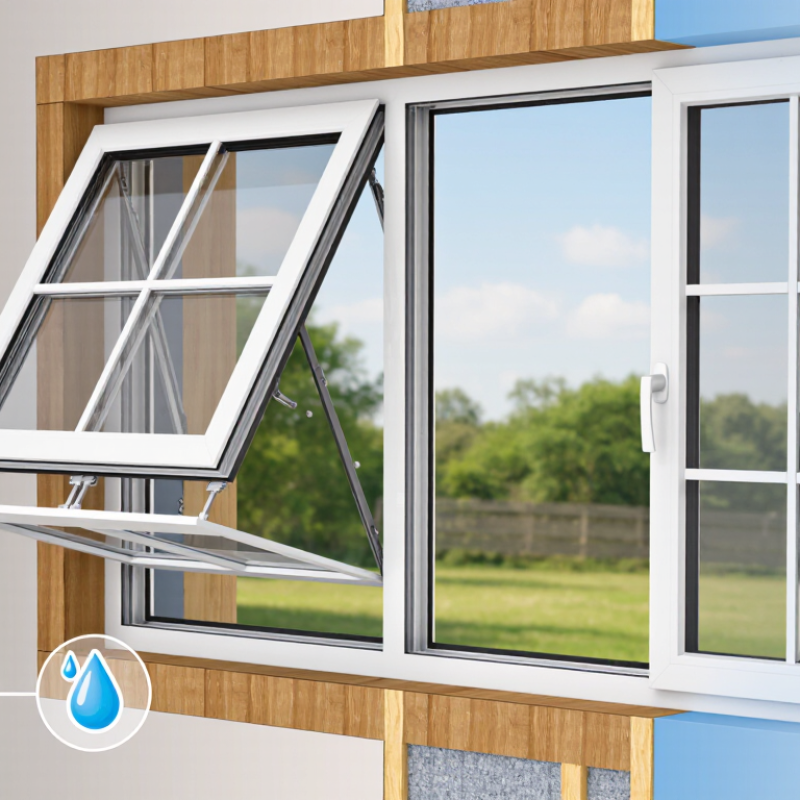
Vinyl tilt-and-turn windows use one sash with two opening actions. Turn the handle upward, and the top edge tilts inward for controlled ventilation. Rotate the handle sideways, and the sash turns inward like a door. This opening position supports cleaning and can provide a wide emergency exit, where local requirements permit it. The hardware must feel firm, not loose or gritty.
The frame usually uses extruded vinyl, often with several internal chambers. These chambers reduce heat transfer and improve rigidity. Steel or composite reinforcement may be added around larger sashes. Look closely at the corners, seals, drainage paths, and glazing spacers. A triple-glazed unit may improve insulation, but it also adds weight. That weight can affect hardware life if the design is poorly balanced. Small details matter.
NFRC ratings describe the complete window, not only the glass. U-factor measures heat flow; lower values generally indicate better insulation. Solar Heat Gain Coefficient, or SHGC, shows how much solar heat enters. Lower SHGC can help sunny rooms, while higher SHGC may benefit cold, shaded climates. Visible Transmittance indicates daylight levels. Air Leakage measures how much air passes through the closed unit. Lower is better. Condensation Resistance can help compare winter performance, but it is not a guarantee. A higher rating is not always better. Match each number to the room, climate, orientation, and ventilation needs. Verify the NFRC label for the exact size and configuration. Small oversights happen, especially when installers compare only center-glass values.
| Data Dimension | Typical Specification or Range | What It Means | Selection Guidance |
|---|---|---|---|
| Basic Window Type | Vinyl tilt-and-turn window | A dual-function window that tilts inward from the top for ventilation and turns inward from the side for a larger opening. | Choose this design when controlled ventilation, interior cleaning, and a strong weather seal are priorities. |
| Tilt Opening | Top edge tilts inward; opening angle commonly about 10–20° | Provides limited ventilation while helping reduce direct rain entry compared with a fully opened sash. | Useful for bedrooms, bathrooms, offices, and upper-floor spaces where secure ventilation is needed. |
| Turn Opening | Side-hinged inward opening; opening angle commonly up to approximately 90° | Creates a wide ventilation path and allows the exterior glass surface to be cleaned from inside. | Confirm that furniture, curtains, radiators, and walkways will not obstruct the inward swing. |
| Operating Hardware | Multi-point locking system with a single handle | One handle normally controls the tilt, turn, and locked positions through perimeter locking points. | Look for clear position markings, smooth operation, corrosion-resistant components, and adjustable hardware. |
| Frame Material | Extruded rigid PVC or uPVC with internal reinforcement where required | Vinyl resists moisture, rot, and many common household chemicals. Reinforcement helps limit frame movement in larger units. | Request the frame profile, reinforcement details, weld quality, and installation tolerances for the intended size. |
| Frame Chambers | Multi-chamber profile; commonly 3–7 chambers | Internal chambers can improve rigidity and reduce heat transfer, but chamber count alone does not determine total performance. | Compare the complete NFRC label and verified frame performance rather than selecting by chamber count only. |
| Glazing Configuration | Double glazing: 2 panes; triple glazing: 3 panes | Additional panes and insulating cavities can reduce heat transfer and improve acoustic performance when correctly designed. | For cold climates, triple glazing may improve comfort; for mild climates, compare cost, weight, solar gain, and visible transmittance. |
| Insulating Gas | Air or inert gas such as argon between glass panes | Inert gas fills can reduce heat transfer within the sealed glazing unit when the unit is properly manufactured and sealed. | Check the glazing build-up, cavity width, and warranty terms rather than relying on gas fill alone. |
| Low-E Coating | Low-emissivity coating on one or more glass surfaces | Low-E coatings reduce radiant heat transfer. Different coatings can emphasize winter heat retention, summer solar control, or balanced performance. | Select the coating according to climate, orientation, shading, daylight needs, and heating or cooling loads. |
| NFRC U-Factor | Lower values indicate better insulating performance; compare the whole-window value | The NFRC U-Factor measures heat flow through the complete fenestration product, including frame and glazing. It is commonly reported in Btu/(h·ft²·°F). | Use the whole-window U-Factor on the NFRC label. Do not substitute the center-of-glass value for the complete window value. |
| NFRC Solar Heat Gain Coefficient | Rated from 0 to 1; lower values admit less solar heat | SHGC indicates the fraction of incident solar radiation that enters a building through the window as heat. | Lower SHGC can help reduce cooling loads in hot, sunny exposures; a higher value may provide useful passive solar heat in cold climates. |
| NFRC Visible Transmittance | Rated from 0 to 1; higher values transmit more visible daylight | VT describes how much visible light passes through the complete window assembly. | Balance daylight with glare control, privacy, glass tint, Low-E coating, and the room’s orientation. |
| NFRC Condensation Resistance | Higher ratings indicate better resistance; reported on a relative scale | This rating compares a product’s ability to resist interior condensation under standardized test conditions. It is not a guarantee against condensation in every building. | Consider indoor humidity, ventilation, room temperature, spacers, glass edge design, and installation quality. |
| Air Leakage | Lower tested values indicate less air passing through the closed and locked product | Air leakage reflects the amount of air that passes through gaps in the window assembly under a pressure difference. | Compare certified air-leakage data and ensure the rough opening, perimeter seal, and drainage path are installed correctly. |
| Water Resistance | Look for a tested performance grade or pressure rating appropriate to the exposure | Water-resistance testing evaluates whether water penetrates the window under controlled wind-driven rain conditions. | Use higher tested performance for exposed elevations, coastal areas, high-rise locations, and regions with severe wind-driven rain. |
| Wind Load | Varies by product size, reinforcement, hardware, glazing, and tested design pressure | Wind performance indicates how well the complete window resists structural pressure and deflection during testing. | Match the tested design pressure to local code requirements, building height, exposure category, and project location. |
| Acoustic Performance | Compare tested Sound Transmission Class or outdoor-indoor transmission data where available | Sound performance depends on glass thickness, pane spacing, laminated layers, frame seals, and installation. | For traffic or urban noise, compare the tested acoustic rating of the exact glazing and frame combination. |
| Common Operating Sizes | Available in custom dimensions; maximum size depends on sash weight and structural design | Large or triple-glazed sashes place greater loads on hinges, handles, rollers, and the surrounding frame. | Confirm maximum tested sash dimensions and weight. Divide very large openings into multiple units when appropriate. |
| Maintenance Requirement | Low routine maintenance; periodic cleaning, inspection, and hardware adjustment | Vinyl does not normally require painting, but tracks, drainage channels, seals, and hardware still need care. | Clean drainage paths, lubricate compatible hardware, inspect gaskets, and avoid abrasive cleaners or unapproved solvents. |
| Installation Priority | Level, plumb, square, insulated, flashed, and continuously sealed installation | Installation quality affects air leakage, water resistance, operation, energy performance, and long-term durability. | Use trained installers and follow the product-specific instructions, local building codes, and flashing requirements. |
| Certification Check | NFRC label with product-specific ratings and certification information | The NFRC label allows comparison of tested whole-window energy characteristics across certified products. | Verify that the label applies to the exact frame, sash, glass, spacer, and configuration being purchased. |
| Best-Fit Climate Strategy | Cold: prioritize U-Factor; hot: prioritize SHGC; mixed: balance both | Energy priorities change with climate, orientation, shading, occupancy, and heating or cooling demand. | Use local energy-code requirements and building orientation together with NFRC ratings when comparing options. |
Choose a lower U-factor in heating-dominated climates. A moderate SHGC can admit useful winter sunlight. Hot climates usually need a lower SHGC. Details matter.
No. Window orientation and shading change solar exposure. A shaded north window differs from an unprotected west window. West-facing glass may need stronger solar control. One specification rarely fits every elevation.
Whole-window ratings include the frame, glazing, and edge effects. Center glass values can look better than real installation performance. Compare complete U-factor and SHGC data. The frame still matters.
Low-emissivity double glazing suits many moderate climates. Triple glazing can reduce heat transfer in colder regions. Warm-edge spacers may reduce condensation near the glass edge. Small details matter.
Narrow frames can increase glass area. However, they may leave less room for reinforcement. Deeper multi-chamber profiles often improve stiffness and insulation. Ask for section drawings.
Ask for a tested whole-window air-leakage value. A value at or below 0.3 cfm/ft² at 75 Pa is a useful benchmark. Confirm the test pressure and method. Numbers need context.
Yes. Foam gaps, uneven shims, and weak sill pans can reduce performance. Poor sealing may create drafts beside an efficient frame. Inspect corners and perimeter seals carefully. Installation is not a minor detail.
Move the handle slowly and check every locking point. The gasket should compress evenly around the sash. Inspect a sample corner after repeated cycling. Laboratory results are not perfect promises.
Choosing Vinyl tilt and turn windows in 2026 requires evaluating performance, materials, and long-term value rather than appearance alone. These windows can tilt inward for ventilation or turn inward for full opening, while vinyl frames provide low maintenance and resistance to moisture. Review NFRC ratings, especially U-factor and SHGC, and match them to your climate zone to balance insulation, solar heat control, and daylight. Compare frame profiles, glazing options, thermal breaks, and air leakage ratings of 0.3 cfm/ft² or lower for improved comfort and efficiency.
Before purchasing, confirm that the window system has appropriate AAMA, WDMA, or CSA testing, reliable water-resistance results, and durable hinges, locks, and seals. Estimate total installation costs, including preparation, labor, trim, and possible structural adjustments. Also consider potential U.S. Energy Star savings, routine cleaning, hardware inspections, and future service availability. A careful comparison of ratings, construction quality, installation requirements, and maintenance needs will help ensure the selected windows deliver dependable performance and value over time.