Aluminum folding bifold doors are moving from luxury projects into adaptable residential and commercial spaces. Their appeal is practical: wide openings, slim sightlines, daylight, and flexible ventilation. Yet performance depends on more than an attractive catalog. Frame alloy, thermal breaks, hardware, drainage, glass specification, and installation quality all matter. This guide introduces China’s top 10 suppliers through a buyer-focused lens.
Industry data supports the opportunity. Grand View Research’s Aluminum Doors Market analysis identifies construction growth and renovation demand as major market drivers. It also highlights energy efficiency and durable materials as important purchasing considerations. The International Energy Agency’s Buildings 2023 report reinforces the importance of improving building envelopes and reducing operational energy use. These reports provide useful context. They do not prove a supplier’s reliability. Evidence matters. Each company should be checked against test reports, alloy details, coating systems, warranty terms, and completed project references.
The selection considers manufacturing experience, export capability, customization depth, quality controls, and after-sales support. It also considers details visible on site: a stable corner joint, smooth rollers, aligned meeting stiles, and a dry sill after rain. These small signs often reveal more than polished photography. Still, this is not a perfect ranking. Supplier strengths vary by project, climate, budget, and certification needs. A factory serving a high-volume developer may not suit a custom villa. That limitation deserves attention. Use this list as a practical starting point, then request current documentation and independent verification before placing an order.
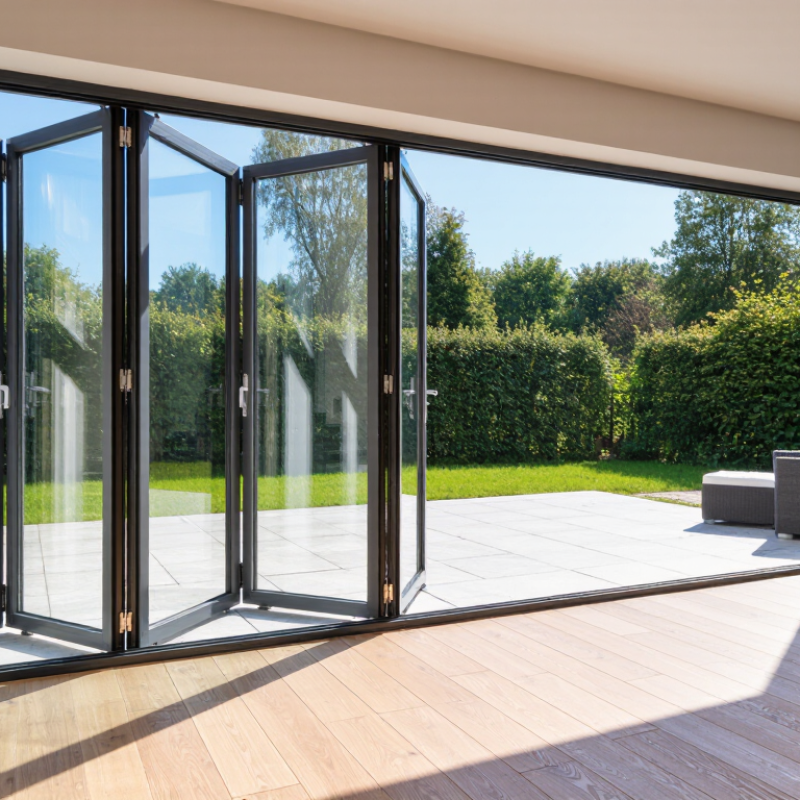
Aluminum folding bifold doors are door systems made from lightweight aluminum panels connected by hinges. The panels fold and stack beside an opening instead of swinging across the room. This design creates a wider passage between indoor and outdoor spaces. It suits patios, restaurants, sunrooms, offices, and modern homes.
Each panel usually includes an aluminum frame, glass, hinges, rollers, seals, and locking hardware. The frame resists moisture, corrosion, and daily movement when properly finished. Tempered or laminated glass can improve safety and sound control. Thermal breaks inside the frame may reduce heat transfer, although performance depends on the complete door system. A strong seal is useful, but it cannot correct poor installation.
Good suppliers should provide tested air, water, wind, and hardware specifications. They should also explain panel weight, opening size, track design, drainage, and maintenance needs. These details matter more than appearance alone. A low threshold looks convenient. However, it may require better drainage planning. Folding doors are not maintenance-free. Dust can collect in the bottom track, and uneven flooring may affect smooth operation. This point is sometimes underestimated. Careful measuring and professional installation help prevent binding, leaks, and uneven gaps.
Leading aluminum bifold door suppliers combine tested performance with practical manufacturing control. For China-based suppliers, look for thermal-break profiles, low-e glazing options, and corrosion-resistant hardware. The U.S. Department of Energy reports that windows can cause 25–30% of residential heating and cooling energy use. This makes frame design more than a visual choice. It affects operating costs.
Reliable suppliers publish air, water, and structural test results. They should also provide NFRC-style U-factor and solar heat gain data where applicable. The National Fenestration Rating Council explains that lower U-factor values generally indicate better insulation. Precise tolerances matter too. A small installation error can weaken an expensive door.
Hardware quality deserves close inspection. Ask about roller capacity, hinge adjustment, drainage paths, and repeated-cycle testing. Suppliers should offer sample corners, finish records, packing details, and installation drawings. Good support is tangible. It includes response times, replacement-part plans, and clear warranty terms.
However, test data alone cannot guarantee field performance. Site exposure, opening size, and installer skill can change results. I would request a full-size sample before approving a large order. It may feel slow. That hesitation often reveals problems early. Industry guidance from FGIA also emphasizes verified testing and consistent product labeling, yet smaller suppliers may present incomplete documentation. Compare evidence, not promises.
China Top 10 Aluminum Folding Bifold Door Suppliers
Ranking the top suppliers requires more than comparing online catalogs. The evaluation should examine manufacturing experience, engineering capability, and verified project performance. Suppliers with stable production records deserve greater confidence. However, factory age alone proves little.
Product quality is assessed through aluminum alloy grades, profile thickness, thermal breaks, drainage design, and hardware durability. Testing records should cover air infiltration, water resistance, wind pressure, and repeated opening cycles. Certifications help, but documents must be current and traceable. Reviewers should also inspect production lines, quality checkpoints, packaging methods, and sample consistency. A beautiful sample can hide weak batch control. That risk matters.
Tips: Request detailed drawings, test reports, warranty terms, and recent project references. Compare lead times, minimum order quantities, customization limits, and after-sales response. Ask how defects are recorded and corrected. Transparent answers usually indicate stronger management. Still, ranking suppliers is not perfectly objective. Available data may be incomplete, and one successful project cannot represent every order. Independent inspections and physical samples remain valuable before any purchase decision.
The ranking framework evaluates aluminum folding bifold door suppliers using commonly applied sourcing criteria. The percentages represent the relative importance assigned to each criterion in a structured supplier assessment, with a total weighting of 100%.
China’s Top 10 Aluminum Folding Bifold Door Suppliers
China’s top 10 aluminum folding bifold door suppliers should be assessed beyond catalogue images. Factory experience matters, especially for large openings, coastal projects, and frequent daily use. The International Energy Agency reports that buildings consume about 30% of global final energy. Therefore, thermal breaks, glass specifications, airtight seals, and installation quality deserve close attention. A beautiful door can still perform poorly.
Supplier comparison should include verified U-values, air leakage results, water resistance, wind-load testing, and hardware cycle records. EN 14351-1 and ASTM testing references can help buyers compare technical claims. Ask for dated laboratory reports, not only sales brochures. Not all quotations are comparable. Aluminium alloy grade, wall thickness, glass composition, drainage design, and packaging protection can change the final cost considerably.
A practical review of China’s top 10 suppliers should also examine production controls. Look for documented inspections, sample approval procedures, traceable hardware, and clear warranty terms. The World Green Building Council links better building performance with efficient envelopes and responsible design decisions. Still, energy performance depends on installation details. This is where many projects become less certain. Request a full-size mock-up when possible, then inspect folding alignment, handle force, seal compression, and threshold drainage. A lower price may be reasonable, but unexplained savings deserve reflection before approval.
Choosing among China’s top aluminum folding bifold door suppliers requires more than comparing online prices. A polished website can still hide weak production control. Request the factory address, business license, and recent project references. Video tours help, but an independent factory audit offers stronger evidence.
Ask about the aluminum alloy, wall thickness, thermal-break design, and surface treatment. Confirm whether the supplier follows recognized testing standards for air, water, wind, and hardware durability. Request a full-size sample, not only catalog images. Open it repeatedly. Check roller movement, gasket pressure, corner joints, and locking alignment. Small defects become expensive after installation.
Review drawings before signing. They should show panel sizes, tolerances, glass specifications, drainage, and installation details. A reliable supplier explains limitations instead of promising everything. That matters. Confirm packaging, replacement parts, inspection procedures, production dates, and warranty responsibilities in writing. Communication quality is also a practical test; unclear answers during sampling may become serious delays later. Do not select the lowest quotation automatically. Compare the complete cost, including shipping, taxes, installation support, and possible rework. Even experienced buyers can overlook drainage or local climate requirements. A second technical review is worth the extra day.
| No. | Evaluation Dimension | Recommended Benchmark | Documents or Evidence to Request | Suggested Weight | Why It Matters |
|---|---|---|---|---|---|
| 1 | Product Compliance | Products should be designed for the destination market and applicable building requirements. | Test reports, technical declarations, installation instructions, and market-specific compliance documents. | 15% | Non-compliant doors may cause approval delays, replacement costs, or installation problems. |
| 2 | Aluminum Profile Quality | Confirm alloy, temper, wall thickness, dimensional tolerance, and surface-treatment specification. | Profile drawings, material certificates, coating specifications, and sample cross-sections. | 12% | Profile strength and dimensional accuracy affect durability, alignment, and weather performance. |
| 3 | Hardware and Hinge System | Hardware should support the specified panel weight, opening frequency, and corrosion environment. | Hardware specifications, load ratings, cycle-test records, adjustment instructions, and spare-parts list. | 12% | Bifold doors depend on hinges, rollers, locks, and guides for smooth and reliable operation. |
| 4 | Air, Water, and Wind Performance | Performance values should match the project’s climate, exposure, and building-design requirements. | Independent laboratory reports, test standards, test pressures, and product configuration tested. | 15% | A door’s performance depends on the complete assembled system, not only the aluminum frame. |
| 5 | Customization Capability | Supplier should provide approved drawings for dimensions, panel layout, opening direction, glass, color, and hardware. | Shop drawings, section details, color samples, mock-up process, and change-control procedure. | 10% | Accurate customization reduces site modifications and prevents mismatches between drawings and production. |
| 6 | Manufacturing and Quality Control | Use documented inspection procedures from incoming materials through final assembly and packing. | Quality-control plan, inspection checklist, nonconformance procedure, factory audit access, and inspection photos. | 12% | Consistent process control helps prevent defects in finish, dimensions, glazing, and hardware installation. |
| 7 | Lead Time and Production Capacity | Capacity and schedule should be confirmed against the project quantity, customization level, and shipping plan. | Production schedule, capacity statement, sample lead time, order milestones, and delay-escalation process. | 8% | A realistic schedule supports construction planning and reduces the risk of incomplete deliveries. |
| 8 | Packaging and Shipping Protection | Packaging should protect finished surfaces, glass, corners, hardware, and identification labels during transport. | Packing photographs, loading plan, crate specifications, labeling format, and damage-claim procedure. | 6% | Proper packaging reduces scratches, breakage, missing parts, and installation delays. |
| 9 | Installation and After-Sales Support | Supplier should provide clear installation guidance, troubleshooting support, and replacement-part availability. | Installation manuals, detail drawings, response-time policy, warranty terms, and spare-parts quotation. | 5% | Technical support is important when site conditions or adjustment requirements differ from the original plan. |
| 10 | Commercial Terms and Total Cost | Compare the complete delivered cost, including tooling, packaging, shipping, duties, installation accessories, and warranty coverage. | Detailed quotation, payment terms, Incoterms, validity period, warranty exclusions, and change-order charges. | 5% | The lowest unit price may not represent the lowest total project cost. |
| Total Recommended Evaluation Weight | 100% | Use the same scoring method for every shortlisted supplier. | |||
Check manufacturing experience, engineering ability, test records, and recent project references. Factory age alone proves little.
Ask about alloy grade, profile thickness, thermal breaks, surface treatment, and drainage design. Small profile weaknesses can cause later problems.
Request current, traceable tests for air infiltration, water resistance, wind pressure, and repeated opening cycles.
A full-size sample reveals roller movement, gasket pressure, corner joints, and locking alignment. Catalog images cannot show these details.
Open the panels repeatedly. Check smooth movement, tight seals, aligned locks, and stable corner connections. Do not rush this step.
Drawings should show panel sizes, tolerances, glass specifications, drainage paths, and installation details. Missing dimensions may create costly rework.
Request the factory address, business license, production videos, and recent references. An independent factory audit offers stronger evidence.
Confirm lead time, minimum order quantity, packaging, spare parts, inspections, warranty duties, and replacement procedures in writing.
Not automatically. Compare shipping, taxes, installation support, and possible rework. The cheapest offer may become expensive later.
No ranking is perfect. Data may be incomplete, and one successful project cannot represent every order. A second technical review helps.
This guide introduces Aluminum folding bifold doors, explaining how their connected panels fold smoothly to create wide openings while improving natural light, ventilation, and space efficiency. It outlines the main features of leading suppliers, including durable aluminum profiles, reliable hardware, thermal insulation, weather resistance, customizable sizes and finishes, professional engineering, and consistent quality control. The article also explains the criteria used to rank China’s top 10 suppliers, such as manufacturing capability, product performance, design flexibility, certifications, delivery reliability, customer service, and overall value.
For buyers, selecting the right Chinese bifold door supplier requires more than comparing prices. The guide recommends evaluating product specifications, factory experience, customization options, testing standards, communication efficiency, installation support, warranty policies, and after-sales service. By considering these factors carefully and matching them with project requirements, property owners, architects, and contractors can identify a dependable supplier and choose Aluminum folding bifold doors that provide lasting performance, attractive design, and practical functionality.